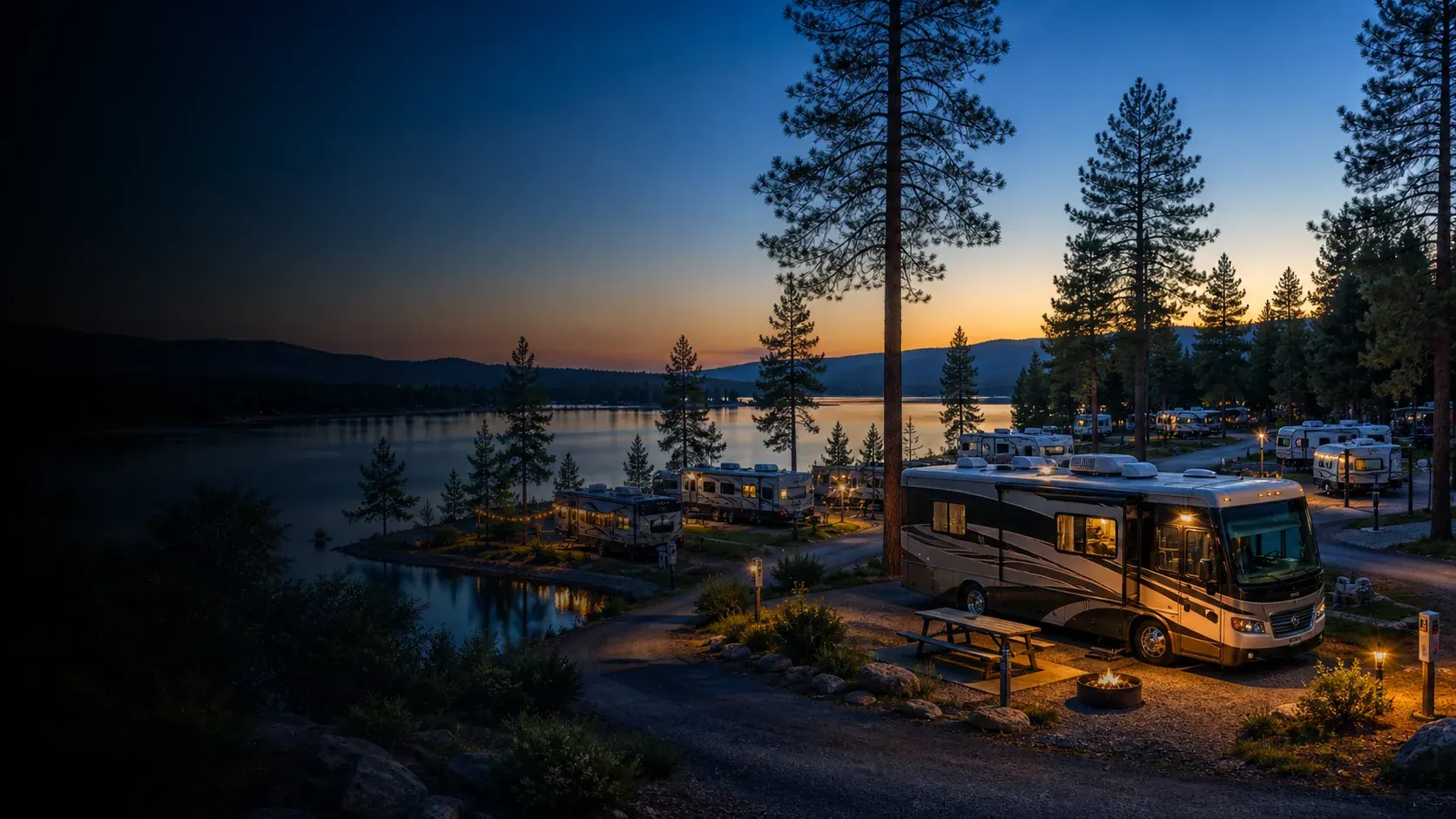
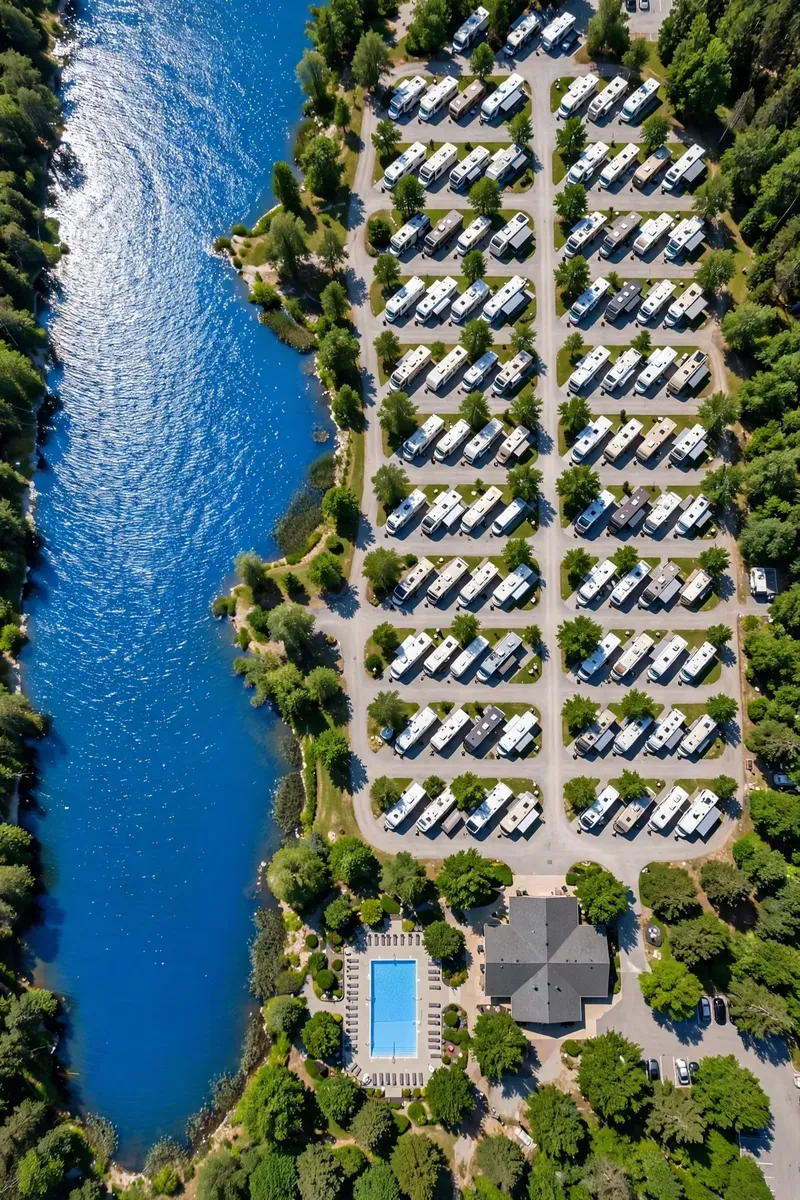
RV park websites built to help guests compare your park, trust your offer, and book faster.
Your RV park website has to compete with directories, booking platforms, Google Maps, AI answers, and nearby parks. Magrify helps your own site become the clearest place to see your sites, rates path, amenities, photos, directions, reviews, and booking step.
An RV park website should organize the six core pages guests expect: Home, Sites & Rates, Amenities, Location and Directions, Photo Gallery, and Reservations or Booking. It should also connect to your booking engine, Google Business Profile, reviews, local SEO pages, and follow-up system.
Where your website fits
Your RV park website should work with directories, maps, and booking platforms without disappearing behind them.
Guests may find you in many places. Your own website should still be the cleanest explanation of your park and the easiest route to the right next step.
Own website
Your own site should be the source of truth for rates context, site types, cabins, amenities, policies, directions, photos, reviews, monthly stays, and booking options.
Directories
RV Parky, Campendium, The Dyrt, Good Sam, Go RVing, Hipcamp, Recreation.gov-style results, and local directories can help guests discover you, but they cannot replace a clear owner-controlled website.
Booking platforms
Campspot, RoverPass, ResNexus, Airbnb, VRBO, Booking.com, Expedia, and similar tools can help with reservations and reach. Magrify improves the website layer around those tools.
Conversion layer
Your website should turn attention into action with sticky mobile CTAs, direct booking buttons, phone and SMS paths, visible reviews, map context, and fast follow-up.
What Magrify can improve for you
Home, Sites & Rates, Amenities, Location and Directions, Photo Gallery, and Reservations page planning
Online booking setup and booking platform support
Campspot, RoverPass, ResNexus, Airbnb, VRBO, Booking.com, Expedia, and major platform handoffs
Mobile booking CTA, click-to-call, SMS, inquiry, and monthly-stay paths
Amenity, local guide, policy, map, and directions content
Photo organization, review proof, social proof, and listing presentation
Schema, metadata, sitemap coverage, analytics events, and follow-up touchpoints
Practical outcomes
A mobile-first RV park website that makes booking, calling, texting, or asking about monthly rates easy
Clear site, cabin, amenity, rate, location, direction, policy, and photo sections guests can scan quickly
Better support for Google Search, Google Maps, AI summaries, Campspot, RoverPass, ResNexus, Airbnb, VRBO, Booking.com, Expedia, Good Sam, RV Parky, Campendium, The Dyrt, and other discovery channels
Related services
Connect this work to the rest of your online system.
Not every park needs a new website. Here is how to tell which one you are:
Fix it if the design is fine but bookings leak: slow pages, buried rates, a booking engine handoff that confuses people, or Google showing an outdated listing. A targeted rebuild of the weak pages usually does it.
Start fresh if the site is not mobile-friendly, runs on software nobody updates anymore, or was built around a business model you have outgrown. Patching a fundamentally broken foundation costs more than rebuilding.
The free audit answers this directly for your site. No obligation and no sales call disguised as an audit.
What "booking-ready" means in practice
It is a checklist, and every item is verifiable:
Guest can reach availability in two taps from the homepage on a phone
Rates, site types, and policies are readable without logging in anywhere
Phone number is tappable on every page
Booking engine handoff keeps your branding and does not ask guests to re-learn navigation
Confirmation and follow-up emails go out automatically
Missed calls get an automatic text back
Review requests go out after checkout without staff remembering to send them
Site loads quickly on a mid-range phone
If your current site fails more than two of these, it is costing you bookings every week.
Direct bookings vs OTA commissions
Every reservation that comes through a big travel platform costs you a commission, often 15 percent or more. A website that ranks and converts shifts that mix toward direct bookings, where you keep the full rate and own the guest relationship for the next stay. That is the entire business case for investing in your own site: it pays for itself the first month it moves a handful of bookings from OTA to direct.
The standard
What the best RV park websites include
Sites and rates pages guests can scan in seconds, with clear paths to availability
Booking buttons that follow the visitor on mobile, so the next step is always on screen
Real photos of actual sites, not stock imagery
Site-level detail: pull-through vs back-in, amp service, max rig length
Location and directions with written entrance notes and big-rig access details
Reviews shown on the site, not hidden three clicks deep
Direct booking engine integration with Campspot, RoverPass, ResNexus, or whichever platform you use
Fast loading on phones with compressed images
Types of RV park websites we build
Not every park needs the same website. Here are the patterns we build most:
Single-location parks. The classic: homepage, sites and rates, amenities, location, gallery, reviews, booking. Tight, fast, conversion-focused.
Multi-location groups. One brand, many parks. Location finder, individual park pages with local SEO, centralized booking.
Monthly and extended-stay parks. Application flows, monthly rate tables, snowbird and workamper content, community pages.
New parks and conversions. Launch sites that build waitlists and early bookings before the gates open.
Every type gets the same foundation: mobile-first design, visible booking path, real photography guidance, local SEO, and analytics from day one.
Getting your RV park website is three steps
Free audit. Magrify reviews your current site and finds where it leaks bookings: hidden calls to action, slow pages, weak mobile flow, missing rate context, thin local SEO.
Free mockup. You see a mockup of the new homepage before anything is final. If the direction is wrong, you say so before a dollar moves.
Build and launch. Most projects finish in two to three weeks. Your booking engine, Google Business Profile, reviews, and follow-up get connected, and the site goes live.
Pricing
Clear pricing, stated up front
Most website projects at Magrify stay under $1,000 to build. Ongoing website care plans stay under $99 per month. You get a straight number before work starts, and the free mockup means you never pay to discover you do not like the direction.
Compare your options
How Magrify compares
Owners usually ask how this stacks up against the other names in RV park websites. Here are the prices those companies publish, and the terms that come with them.
Company
Website price
Magrify
Under $1,000, one time
RV Park Websites (rvparkwebsites.com)
$189/mo
RV Park Sites (rvparksites.com)
From $85/mo
Happy Websites
$99/mo
Campground Management
$2,500 one time, plus $49/mo
The bigger differences are in the terms. Magrify has no contract and no minimum term, and you own your website outright. Optional care plans run $19.99 to $99 a month, month to month, if you want updates and reporting handled. RV Park Websites requires 24 months at $189 a month, which is $4,536, and their own FAQ says the website is leased, so you own nothing when the term ends. Included support there is capped at 30 minutes of changes a month. RV Park Sites charges from $85 a month with a 12-month minimum, and their FAQ says you own the site, code, domain, and content.
Competitor pricing and terms are from the competitors' own public pages, checked November 2026.
Recent work
Real sites you can open and judge for yourself
Every ranking competitor shows their work, so here is ours. These are live sites Magrify built or improved. Open them and look at the booking flow, the mobile layout, and how fast they load.
Most projects under $1,000. You own the site; no monthly rental.
Your booking software
Works with Campspot, RoverPass, ResNexus, and more. No forced switch.
Real prices published
No vague quotes. Every price is listed before you ever call.
All 50 states
Local pages and SEO for parks anywhere in the country.
Client reviews
What clients say about Magrify
Magrify has been the best decision for our vacation rental business in Texas. Their custom approach and 24/7 support has made the web design process easy and stress-free. Our booking plug-in now connects our Airbnb and other listing calendars seamlessly!
Lida E — 5-star Google review
Excellent experienced web developers and coding help!! They will solve all of your IT and website problems. Good prices too! Thank you Magrify.
Michelle Enloe — 5-star Google review
About the author
Built by someone who answers the phone
Jack Magri is the founder of Magrify, a Texas-based studio for RV park and hospitality websites. He works directly with park owners on booking-ready websites, local search, and the follow-up systems that turn lookers into reservations. No account managers, no handoffs. When you call (469) 269-0355, you get Jack.
Before starting Magrify, Jack managed properties and saw firsthand how many bookings leak through slow sites, buried rates pages, and booking engines that feel bolted on. Most Magrify website projects stay under $1,000, and every project starts with a free mockup so you can see the work before you commit.
Quick answers
What separates top-ranking RV park websites from the rest
Search "rv park websites" and you will see two kinds of results: directories listing parks, and designers building park sites. The parks that win bookings have websites that do three jobs at once: rank on Google, convince visitors, and convert them into reservations.
1. They answer the guest's real questions
The best RV park websites put rates, availability, site types, hookups, and pet policies where guests can find them in one click. Every extra click loses bookings. If a guest has to call to ask the price, the website failed.
2. They load fast on a phone in a dead zone
Guests browse parks from the road, often on weak cell signals. A site that loads fast on 4G wins. Heavy sliders, autoplay video, and uncompressed photos kill conversions.
3. They are built around the booking engine
The booking button should be visible without scrolling on every page. The reservation system, whether Campspot, RoverPass, ResNexus, or direct, should feel like part of the site, not a jarring redirect to a third-party page.
4. They show the park, not stock photos
Real photos of real sites, real hookups, real views. Guests can spot stock photography instantly, and it erodes trust. A phone camera and good light beats a stock library every time.
5. They rank for their own name plus their market
The site should own searches for the park name, the park name plus "rv park", and "rv park near [town]". That means proper title tags, a connected Google Business Profile, and location pages that mention the town, nearby attractions, and highways by name.
That is what we build. Every RV park web designer project at Magrify starts from this checklist, not from a template.
Questions you may ask before you start.
Can Magrify help with RV park websites?
Yes. Your RV park website has to compete with directories, booking platforms, Google Maps, AI answers, and nearby parks. Magrify helps your own site become the clearest place to see your sites, rates path, amenities, photos, directions, reviews, and booking step. Magrify can improve the public pages, calls to action, search signals, platform handoffs, and follow-up around this work.
Do you need to replace your current software?
No. Magrify can usually improve your website, booking engine, CRM, listing, or follow-up setup around the tools you already use.
How easy is it to start?
Your name and best contact method are enough. Magrify can ask for anything else only if it is needed next.
What is the best platform for an RV park website?
There is no single best platform. What matters is fast loading, easy rate updates, clean booking engine integration, and pages Google can read. Magrify builds lightweight sites tuned for parks rather than forcing a heavy page-builder theme.
How do I get more direct bookings instead of OTA reservations?
Three things: rank for your park name plus nearby towns, make the direct booking path obviously easier than the OTA path, and follow up automatically with past guests. The website is the foundation all three stand on.
Do you work with parks outside Texas?
Yes. Most clients are Texas parks, but the work is remote-friendly and the process is the same anywhere in the US.
What should every RV park website include?
At minimum: Home, Sites and Rates, Amenities, Location and Directions, Photo Gallery, Reviews, FAQs, and a Reservations or Booking page. Every one of those pages needs a visible booking call to action, especially on mobile, where most of your guests are browsing.
How much does an RV park website cost?
Large agencies typically quote $8,000 to $25,000 for hospitality websites. Most website projects at Magrify stay under $1,000 to build, and ongoing website care plans stay under $99 per month. You get a straight number before work starts, and a free mockup of the new homepage before anything is final.
How long does it take to build an RV park website?
Most projects run two to three weeks from kickoff to launch. A simple refresh of an existing site can be faster. The timeline is confirmed before work starts, not discovered halfway through.
Can you redesign my current RV park website instead of starting over?
Yes, and that is often the smarter move. It starts with a free audit that finds where the current site leaks bookings: hidden calls to action, slow pages, weak mobile flow, or thin local SEO. Then Magrify fixes what is broken and rebuilds only what needs rebuilding.
Will my RV park website connect to my booking software?
Yes. Magrify connects sites to Campspot, RoverPass, ResNexus, and other booking tools without asking you to replace what already works. The goal is a clean handoff from your website to your booking engine, not a second system to manage.
Do RV park websites still matter when directories like RV Parky exist?
Yes. Directories help travelers discover parks, but they do not replace your own site. Your website is the only place where you control the rates story, the photos, the reviews shown, and the booking path. Parks that rely entirely on directories rent their visibility; a strong website owns it.
Next step
Want your RV park website cleaned up?
Start with your name and best contact method. Magrify will keep the next step simple. Prefer to check your site yourself first? Run the free website grader for an instant scorecard.
 Magrify